

The clarity you want from ERP, without the complexity you dread.
One system your entire company operates on, with workflows that your team will find familiar from day 1.
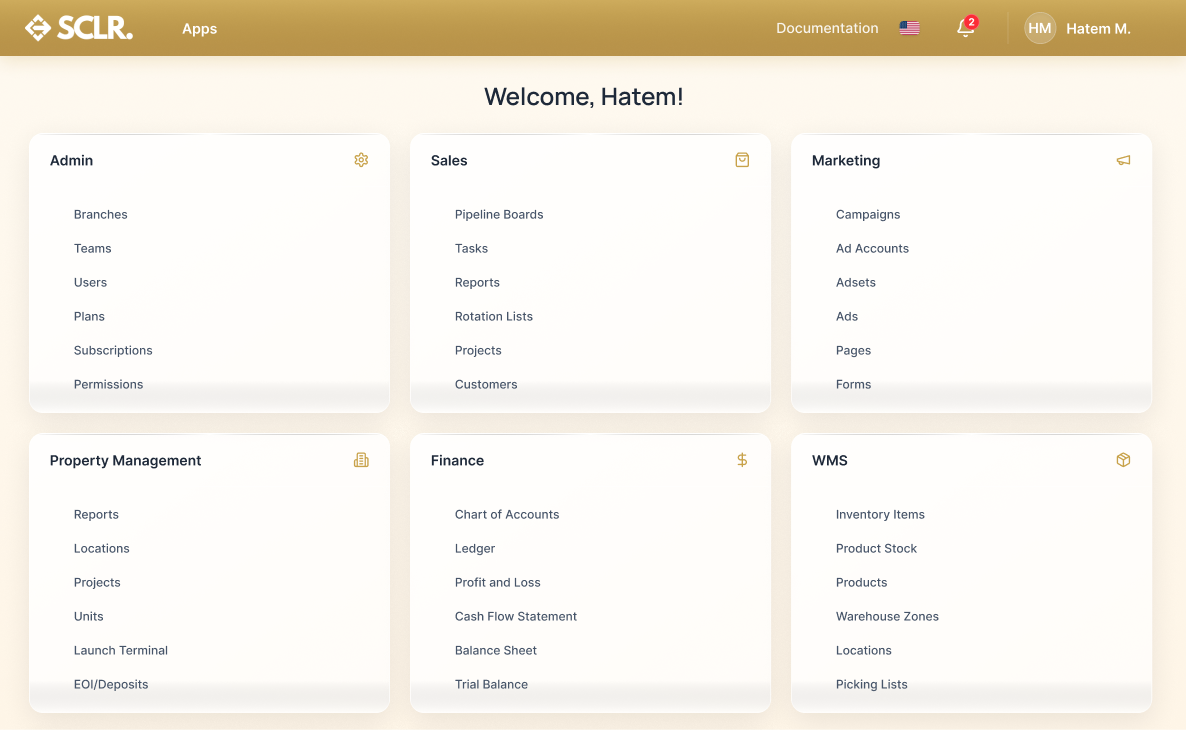
Nothing falls through the cracks. What happens in one department shows up everywhere.
Every department runs its own module. What happens in one automatically
shows up where it
needs
to across the rest — no manual handoffs.
A lead enters the pipeline with every action, follow-up, and stage tracked all the way to the close.
A purchase request is submitted and sent to suppliers for quotes, with approvals at every step until the order is fulfilled.
When goods arrive, they go to their designated locations, stock levels update automatically, and every move is recorded.
Invoices are posted, checks are created, and every payment is tracked into its account and shows up in your financial reports.
Attendance, expenses, and payroll run alongside your full recruitment pipeline, all from one employee record.
Every transaction gets reported as it happened across the business, giving you one connected record that's always up-to-date.
Scaler fills the gaps with 9 core modules.
Sales
Pipeline, lead distribution, activity tracking, and commission structures all tied to one lead record.
Order Management
Quotations, sales orders, proof of delivery, and invoicing triggered from Sales and wired to Warehouse and Finance.
Marketing
Connected Meta campaigns with lead form sync, budget pacing, and conversion data flowing back from Sales.
Real Estate Commercial Operations
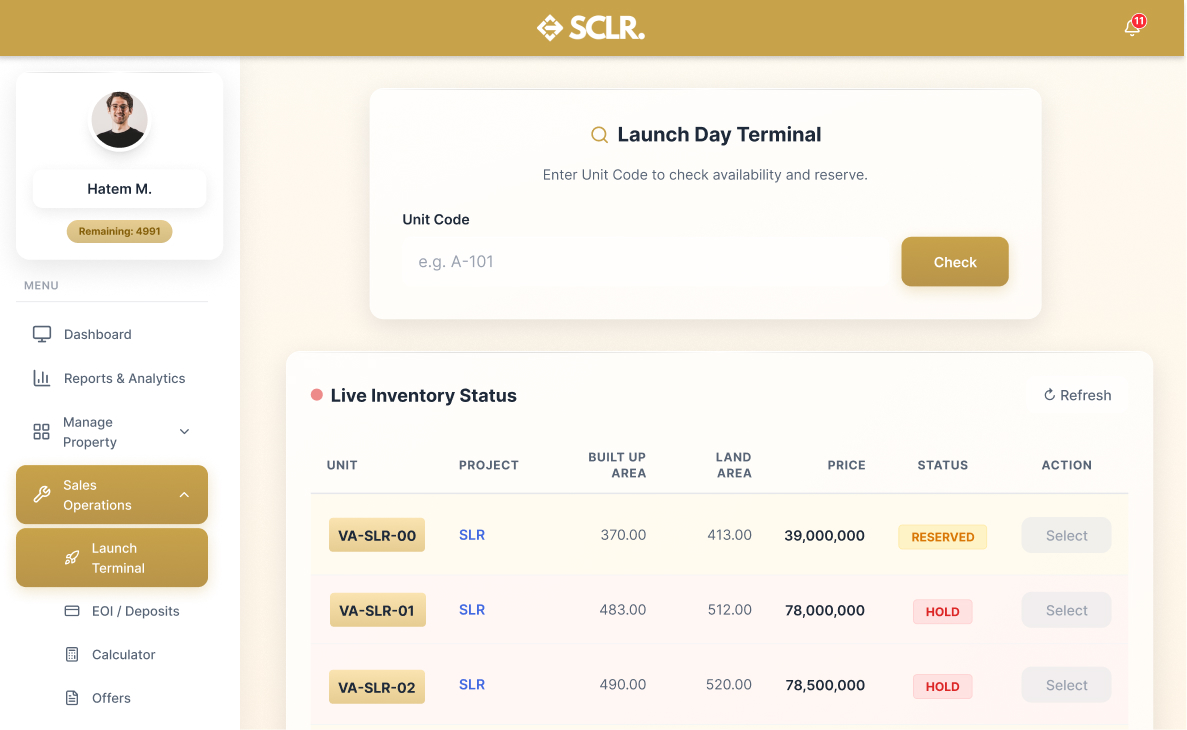
Availability, EOI, quotation, contract, and payment schedule posted to Finance the moment a contract is signed.
HR
Recruitment pipeline, employee records, attendance rules, leave management, and self-service from one record.
Payroll
Salary components, structures, employee contracts, payroll runs, and automatic Finance posting no manual entries.
Finance
Accounting rules, general ledger, financial reports, and period close every module posts here.
Procurement
From purchase request through vendor quotation, PO, goods receipt, and invoice to payment one purchasing trail.
Warehouse Management
Goods receipt against POs, picking lists from sales orders, cycle counts, and batch and expiry tracking.
This is what end-to-end actually looks like.
Each flow shows you how one action in one department automatically triggers the next, one trail with your money tracked at every step.
From closed deal to collected payment, finances tracked automatically without manual handoffs.
Admin-enabled per user. Operates within your configured permissions.
An AI assistant that already knows your whole business.
It lives inside the same system as your data. Ask what's happening in sales, whether a payment has come through, or how to set up a payroll rule — and get a direct answer. No setup. No context to manage.
Ask anything about the system — setup, flows, approvals, fields. Get a direct answer without hunting through documentation.
Ask about any department, customer, or record and get reported to instead of navigating to find it.
Agent mode will perform tasks and run flows on your behalf — within your existing permissions and approvals.
Your tools stay. Your data gets better.
Plug your existing tools into Scaler via APIs and webhooks. Now they're pulling from one live record that your whole business runs on — not fragmented department exports.
- Financial accuracy — every tool feeds one accounting engine. Month-end doesn't require pulling from five places.
- Front-to-back connection — a transaction in a front-office tool triggers the back-office automatically. The gap between departments closes.
- Visibility over your whole stack — tools your teams are already running get connected. No more islands operating outside the system.
- External sources flow in — orders, transactions, or data from outside platforms arrive without manual entry.
- Our team handles the connection — if the integration needs to be built, we do it. During implementation or after, on request.
Any tool with a public API or webhook can be connected to Scaler.
Implementation has a clear shape.
Four steps from your current setup to live. You'll have full documentation inside the system at every step, and our team working with you throughout.
Step 01
Map your processes
You and your department heads map how you currently operate — what's coming into the system as-is, and what you want to run differently going forward.
Step 02
Prepare and migrate your data
Gather and clean your records, structure them to match the system, and import using ready-made templates. Your data moves in organized.
Step 03
Configure your workspace
Your admin sets up the system first — permissions, working rules, HR and payroll policies. Then your managers come in to configure their own modules. By the end, Scaler reflects how your company actually runs.
Step 04
Go live
Invite your employees. That's your go-live. Training happens inside the live system, with real data and real workflows from day one.
Implementation doesn't take months.
The transition is smoother than you think. Scaler is built around the terms and workflows your team already recognizes no maze to navigate, no months of getting used to a complicated, foreign system.